

ISIS Neutron and Muon Source Data Journal
This is a page describing data taken during an experiment at the ISIS Neutron and Muon Source. Information about the ISIS Neutron and Muon Source can be found at https://www.isis.stfc.ac.uk.
Using QLCR to Study Stopping Sites in Molecular Solids
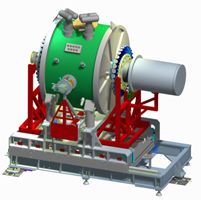
Abstract: Muon nuclear quadrupolar level crossing resonance is not a well-known technique, however it is extremely powerful. There is a large interest in probing the muon stopping site and the behaviour of molecular solids where the elusive diamagnetic muonium fraction is present. For this to work you require a nuclei where I>1, and then the resonance field relates to the electric field gradient across the nuclei. QLCR has been performed on nitrogen and this has been successful, we seek to expend this to molecular solids where there are CN groups present, which are isoelectronic to nitrogen. This will present us with a way to not only probe the muon stopping sites and relate this to physical properties.
Public release date: 12 December 2022
Local Contact: Dr Adam Berlie
Experimenter: Dr Francis Pratt
Experimenter: Dr Stephen Cottrell
DOI: 10.5286/ISIS.E.RB1910597-4
Parent DOI: 10.5286/ISIS.E.RB1910597
ISIS Experiment Number: RB1910597
Part Number: 4

Date of Experiment: 11 December 2019
Publisher: STFC ISIS Neutron and Muon Source
Data format: RAW/Nexus
Select the data format above to find
out more about it.
Data Citation
The recommended format for citing this dataset in a research
publication is as:
[author], [date], [title], [publisher],
[doi]
For Example:
Dr Adam Berlie et al; (2019): Using QLCR to Study Stopping Sites in Molecular Solids, STFC ISIS Neutron and Muon Source, https://doi.org/10.5286/ISIS.E.RB1910597-4
Data is released under the CC-BY-4.0 license.